
- A sound healing certification is a certificate issued by a private school or teacher after you complete their training. There is no national exam, license or government regulation for sound healers in the US.
- Programs range from a single weekend to 200 hours or more, and typically cost from a few hundred to a few thousand dollars, plus instruments.
- Words like "accredited" or "certified" usually refer to a private organization, not a government or medical body, so ask exactly who accredits a program.
- A sound healing certificate qualifies you to lead relaxation and wellness sessions. It does not qualify you to diagnose or treat medical or mental health conditions.
- If you want to use music to work with health goals in clinical settings, the path is becoming a board-certified music therapist (MT-BC).
Maybe you went to your first sound bath and walked out feeling calmer than you had in months. Maybe you already teach yoga or meditation and want to add singing bowls to your classes. Or maybe you've seen the ads promising you can "become a certified sound healer" in a weekend.
Whatever brought you here, it's worth understanding what a sound healing certification really is before you spend your time and money. As a music therapy practice, we get questions about this often. Here's an honest guide to how sound healing certification works, what to look for in a program, what it costs and what it does and doesn't allow you to do.
What Is a Sound Healing Certification?
A sound healing certification is a certificate awarded by a private training provider after a student completes that provider's course in using sound, such as singing bowls, gongs, tuning forks and voice, for relaxation and wellbeing. It shows you finished their program. It is not a professional license.
Most programs teach you how to play common sound healing instruments, how to plan and lead a session or sound bath, and the ideas and traditions behind sound healing. Some also cover business skills like pricing and marketing.
Is Sound Healing Certification Regulated?
No. In the United States, there is no national board, standardized exam or state license for sound healers. Anyone can create a sound healing course and issue a certificate, and anyone can call themselves a sound healer.
You'll see many programs described as "accredited." That usually means a private association has reviewed or registered the course, often one connected to yoga, holistic therapy or complementary wellness. That can be a helpful sign of structure, but it's very different from accreditation by an agency recognized by the US Department of Education.
A few schools go further. For example, one long-running sound healing school in California, the Globe Institute, offers a 186-hour Sound Healing and Therapy certificate and is approved to operate by the state's Bureau for Private Postsecondary Education. Even so, its own disclosures state that its programs are not accredited by an agency recognized by the US Department of Education. That's typical of the field, and it's why asking direct questions matters.
Sound healing and music therapy are often confused, but they are very different. Music therapy is a clinical health profession with a national board certification, while sound healing is a wellness practice with no standard training. We break down the differences in our guide to sound healing vs music therapy.

Types of Sound Healing Certification Programs
Programs vary a lot in length, depth and format. Here's how they generally compare:
| Program type | Typical length | What you usually learn | Good for |
|---|---|---|---|
| Weekend or intro workshop | 8 to 20 hours | Basic playing techniques and how to lead a simple sound bath | Personal practice or trying it out |
| Self-paced online course | 20 to 50 hours | Video lessons on instruments, session flow and theory | Flexible learning on a budget |
| Practitioner certification | 50 to 200 hours | Multiple instruments, session planning, safety, practice sessions with feedback | Yoga teachers, wellness professionals, new practitioners |
| Immersive or retreat training | 5 to 14 days in person | Hands-on practice with many instruments and group sessions | Learners who want in-person feedback |
| Advanced or multi-level programs | 150 hours or more | Deeper study, mentoring and supervised practice | People building a long-term practice |
Many programs focus on one instrument, like crystal bowls, Tibetan-style singing bowls, gongs or tuning forks. Others cover several. Think about which instruments you actually want to use before you choose.
What a Good Program Should Cover
Because there's no standard curriculum, quality depends on the school. A solid program should include:
- Hands-on instrument skills, including how to play softly and safely, not just loudly.
- Session design, from setting up the space to opening and closing a session.
- Safety and contraindications, such as who should avoid loud gongs or strong vibrations, including people with sound sensitivity, certain medical conditions or pregnancy.
- Trauma-informed practice, because deep relaxation can sometimes bring up strong emotions, and participants need to feel safe and in control.
- Scope of practice, meaning clear guidance on what sound healers can and can't claim or do.
- Supervised practice with feedback, ideally with real participants, not just video lessons.
- Honest teaching about the evidence, including what research does and doesn't support.
How Much Does Sound Healing Certification Cost?
Costs vary widely depending on length, format and the instructor's reputation. As a rough guide, short online courses often cost a few hundred dollars, while longer practitioner and in-person programs commonly run from about $1,000 to several thousand dollars. Retreat-style trainings can cost more once you add travel and lodging.
Don't forget equipment. A starter set of singing bowls may cost a few hundred dollars, while quality crystal bowl sets and large gongs can cost thousands. You may also need mats, blankets, a stand for your gong and, if you plan to work professionally, liability insurance.
Before you enroll, compare programs on total hours, live instruction, practice opportunities with feedback, included materials and the refund policy, not just the price.

How to Choose a Sound Healing Program
Ask these questions before you pay:
- Who teaches the course, and what is their background? Look for years of real practice, not just a large social media following.
- How many hours are live versus pre-recorded? Live feedback is where most learning happens.
- Is there supervised practice? Will someone watch you lead a session and give feedback?
- What does "accredited" mean here? Ask for the name of the accrediting organization and check what it actually reviews.
- Does the course cover safety and scope of practice? If it doesn't, keep looking.
- What support is available after you finish? Some programs offer mentoring or a community of graduates.
- Claims that sound healing can cure illnesses, repair DNA or replace medical treatment.
- Promises that you'll earn a full-time income quickly after a short course.
- Pressure to buy expensive instruments from the instructor as part of enrollment.
- No mention of safety, contraindications or when to refer someone to a doctor.
- Specific "healing frequencies" promoted as medicine. Our guide to solfeggio frequencies explains what the research actually shows.
What You Can and Can't Do With a Sound Healing Certificate
A sound healing certificate can prepare you to lead group sound baths, add sound to yoga or meditation classes, offer one-on-one relaxation sessions, or run wellness events and retreats.
What it doesn't do is qualify you to diagnose, treat or claim to cure medical or mental health conditions. Ethical sound healers describe their work as relaxation and wellbeing, encourage clients to keep working with their doctors and therapists, and avoid health claims they can't support.
If someone comes to you with serious anxiety, depression, trauma or a medical condition, the responsible step is to suggest they also talk with a licensed health professional. Sound healing can sit alongside that care, but it shouldn't replace it.
Sound Healing Certification vs Becoming a Music Therapist
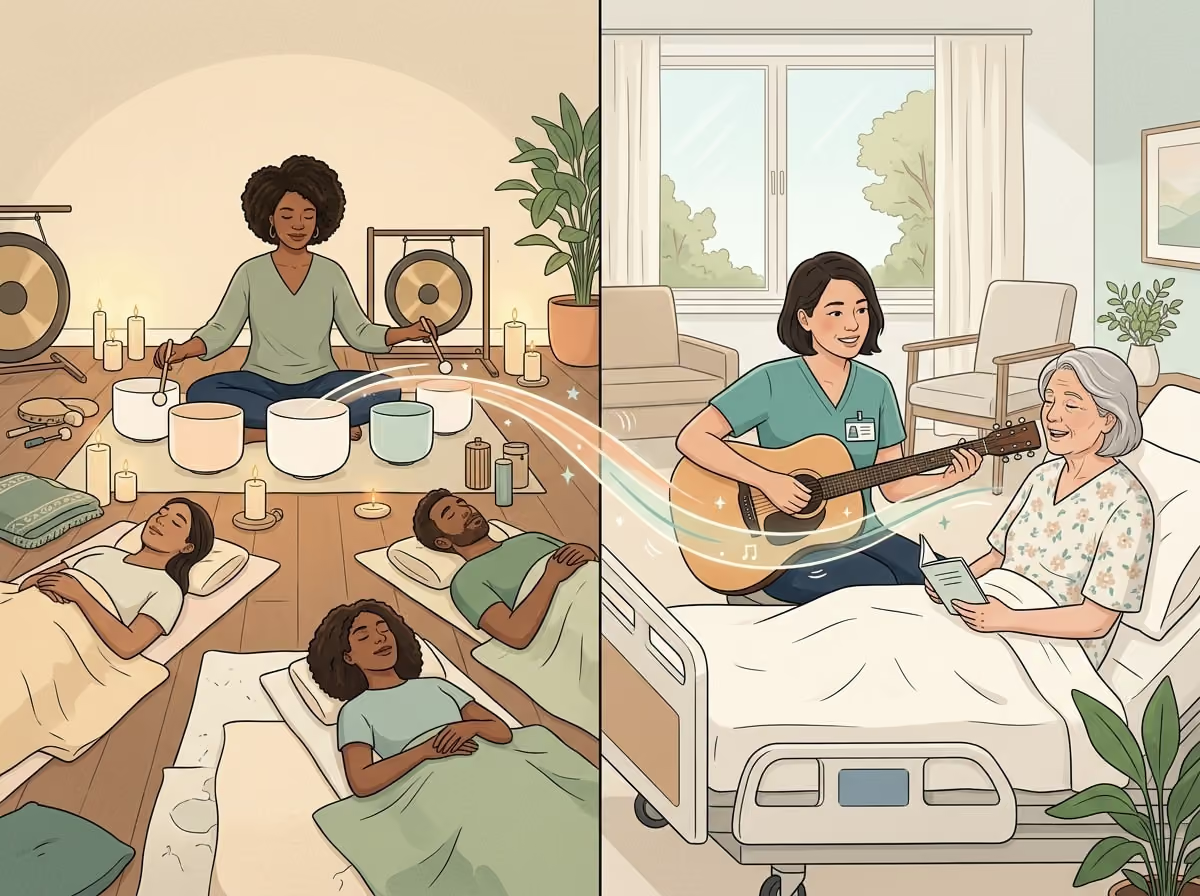
Some people start looking into sound healing and realize what they really want is to help people with health and mental health goals. If that's you, it's worth knowing how the two paths compare.
| Sound healing certification | Board-certified music therapist | |
|---|---|---|
| Training | Private course, from a weekend to 200+ hours | Bachelor's or master's degree in music therapy |
| Clinical hours | Varies, often none required | At least 1,200 hours of supervised clinical training |
| Exam | Set by each school, if any | National board exam |
| Credential | Certificate from the school | MT-BC from the Certification Board for Music Therapists |
| Scope | Relaxation and wellness | Clinical, goal-based care for health and mental health needs |
| Typical settings | Studios, yoga spaces, spas, retreats | Hospitals, schools, hospices, clinics, private practice, telehealth |
Becoming a music therapist takes much longer, but it opens doors to clinical work, insurance billing in some settings and more stable employment. You can learn more about the credential on the Certification Board for Music Therapists website, and see what the career pays in our guide to music therapist salary.
Is Sound Healing Certification Worth It?
It can be, if your expectations are clear. A good program can deepen your personal practice, give you confidence leading sessions and add a meaningful offering to yoga, meditation or wellness work. Choose one with real practice, honest teaching and a strong focus on safety.
It's probably not worth it if you're hoping for a fast, high-paying career, or if your goal is to treat health conditions. In that case, look into music therapy or another licensed health profession instead.
FAQ
Do you need a certification to be a sound healer?
No. In the US, there is no legal requirement or license to practice sound healing. However, completing a quality training program helps you learn safe techniques, build confidence and earn trust from clients and studios, many of which prefer to hire certified practitioners.
How long does it take to get a sound healing certification?
It depends on the program. Introductory courses can take a single weekend, many online practitioner programs take 50 to 100 hours, and in-depth programs can reach 200 hours or more over several months.
How much does sound healing certification cost?
Short online courses often cost a few hundred dollars, while longer practitioner or in-person programs commonly cost from about $1,000 to several thousand dollars. Instruments, travel and insurance can add significantly to the total.
Is an accredited sound healing certification recognized by the government?
Usually not. Most "accredited" sound healing programs are recognized by private associations, not by the US Department of Education or any medical licensing body. Ask each program exactly who accredits it and what that accreditation means.
Can a sound healer treat anxiety or depression?
No. A sound healing certificate does not qualify someone to treat mental health conditions. Sound healing may help some people relax, but anyone with anxiety, depression or other mental health concerns should also work with a licensed professional.
What's the difference between a sound healer and a music therapist?
A sound healer completes a private training course and offers relaxation and wellness sessions. A music therapist completes a music therapy degree, at least 1,200 hours of clinical training and a national board exam to earn the MT-BC credential, and provides clinical, goal-based care.
One Last Thing
Sound can be a beautiful way to help people slow down and feel more at ease. If you choose to train as a sound healer, choose a program that values safety, honesty and practice as much as you do. And if what you really want is to help people with health and emotional goals through music, music therapy might be the path worth exploring.
